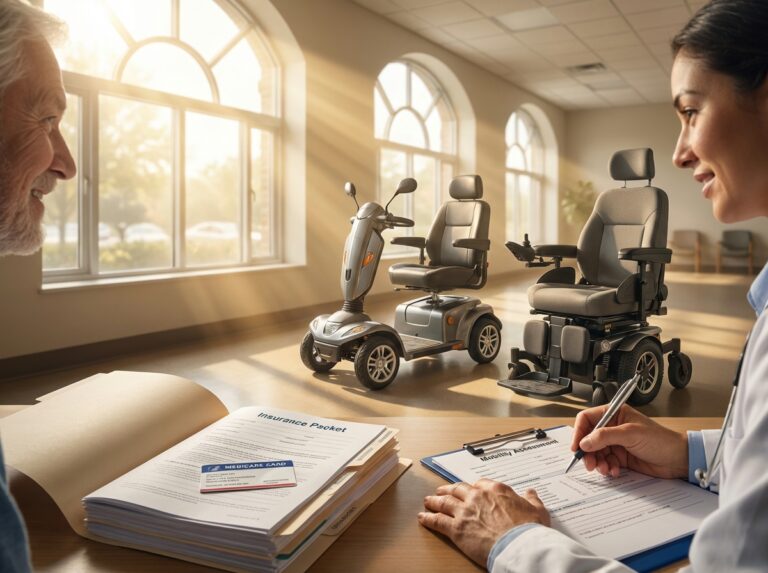
Folding travel power chairs are prized for portability, yet insurers—especially Medicare and some Medicare Advantage plans—often deny coverage. This article examines why folding models commonly fail medical necessity rules, how to document functional need, steps for prior authorization and appeals, and alternative funding options to help you secure mobility equipment.
Why insurers and Medicare often deny folding travel power chairs
Navigating the world of insurance for a power wheelchair can feel like learning a new language, one filled with confusing acronyms and unwritten rules. This is especially true when you’re seeking coverage for a folding travel power chair. While these devices offer incredible freedom and portability, they often hit a wall with insurers, including Medicare. The reason isn’t arbitrary; it’s rooted in strict definitions of what constitutes medically necessary equipment versus a convenience item.
At the heart of most denials is the core definition of Durable Medical Equipment (DME). According to the Centers for Medicare & Medicaid Services (CMS), for a power mobility device (PMD) to be covered, it must be deemed medically necessary to perform Mobility-Related Activities of Daily Living (MRADLs) inside the home. This “in-the-home” rule is the single biggest hurdle. Insurers see the primary purpose of a power chair as enabling a person to safely get to the kitchen, bathroom, and bedroom, not necessarily to the grocery store or on a flight. While you may desperately need it for both, coverage is based on the home environment. The logic is that if you can manage at home with a cane, walker, or manual wheelchair, a power chair won’t be approved, regardless of your needs outside.
This is where the clinical features of a standard, non-folding power chair become critical for coverage. Insurers and Medicare look for components that address specific, documented medical needs for all-day use. These include:
- Custom Seating and Positioning: Features like power tilt, recline, and elevating leg rests are not luxuries. They are medically necessary for individuals who cannot independently shift their weight, are at high risk for pressure sores, or have severe postural or respiratory issues.
- Durability and Performance: A primary-use power chair must have a robust frame and powerful motors designed to withstand thousands of hours of use per year. Its drive system is built for reliability over varied indoor surfaces.
- Adjustability: The ability to precisely adjust armrest height, seat depth, backrest angle, and footplate position is essential for proper clinical support, stability, and function throughout the day.
Folding travel power chairs, by their very design, often lack these critical features. Their product marketing emphasizes what insurers classify as “convenience” attributes. Websites and brochures highlight lightweight frames, quick-fold mechanisms, long-lasting lithium batteries for travel, and compact designs that fit in a car trunk. While these are fantastic qualities, they directly conflict with the insurer’s perspective. The marketing itself can be used as evidence in a denial, with reviewers concluding the product is intended for occasional, recreational use rather than as a primary medical device for daily living.
This mismatch leads to several common denial rationales from Medicare Administrative Contractors (MACs), Medicare Advantage plans, and private insurers. For example, Aetna’s Clinical Policy Bulletin on Wheelchairs (Number 0271, last reviewed March 12, 2024) explicitly states that equipment is considered medically necessary only when it meets specific criteria related to in-home mobility limitations. A chair designed for portability often fails this test.
Here are some concrete denial examples and the reasoning behind them:
- Denial Reason: Not Medically Necessary / Convenience Item.
A reviewer sees a claim for a folding chair and notes its lightweight design and lack of postural support options. The denial letter states the device “does not meet the member’s daily medical needs and is considered a convenience item for travel.” The vendor’s own product description, which may have been included in the submission, might have even used words like “vacation” or “portable,” sealing its fate. - Denial Reason: Duplicate Equipment.
If a person already has a Medicare-funded standard power chair or even a manual wheelchair at home, a folding travel chair is almost always considered duplicative. Insurers will not pay for a “backup” or secondary chair for a different purpose, like travel. They fund one piece of equipment that meets the primary in-home medical need. - Denial Reason: Fails to Meet Local Coverage Determination (LCD) Criteria.
Medicare policy is administered regionally by MACs, and each MAC publishes its own LCDs with specific rules for PMDs. For example, the LCD for Power Mobility Devices (L33787) from Noridian Healthcare Solutions outlines stringent requirements for the clinical evaluation and documentation. A folding chair may not have the necessary options to meet the specific criteria for a given HCPCS (Healthcare Common Procedure Coding System) code, leading to a denial. These rules can and do vary by region, adding another layer of complexity. - Denial Reason: Incorrect Coding by Supplier.
Sometimes, a supplier might try to get a folding chair covered by using a HCPCS code for a more complex standard power chair (e.g., a Group 2 or Group 3 code). This is a red flag. Auditors quickly identify that the product’s specifications do not match the code’s requirements. For instance, a code might require the chair to have specific battery types or seating capabilities that the folding model lacks. This results in an immediate denial for miscoding.
The lack of objective functional data is another major cause for denial. A physician’s note simply stating “patient needs a power chair” is useless. The documentation must paint a clear picture of failure with lesser equipment. It needs measurable data, such as the patient’s inability to self-propel a manual wheelchair more than a few feet, poor endurance, or specific balance test scores (like a Timed Up-and-Go test) that prove they are unsafe at home without powered mobility. Without this hard evidence, the claim lacks the foundation for medical necessity.
Ultimately, the system is designed to provide a functional solution for in-home deficits, not an optimal solution for an active community life. Folding chairs fall squarely into this policy gap. To help you identify the potential pitfalls in your own pursuit of a chair, here is a checklist of the most common reasons a folding travel power chair claim is denied.
- The documentation fails to establish a clear medical need for the chair inside the home.
- The chair is marketed by the manufacturer or vendor primarily for travel, portability, or convenience.
- The submitted clinical evidence lacks objective, measurable data on functional limitations (e.g., distance ambulated, transfer ability, propulsion difficulties).
- The requested chair lacks the necessary seating and positioning features (like pressure-relieving cushions or tilt/recline) required by the patient’s documented medical condition.
- The patient already has another mobility device, making the travel chair “duplicate equipment.”
- The supplier used an incorrect HCPCS code that does not match the specifications of the folding chair.
How to maximize your chance of coverage for a travel power chair
Navigating the insurance maze for a power wheelchair, especially a folding travel model, can feel overwhelming. But with a strategic, detailed approach, you can significantly improve your chances of getting the equipment you need. This guide breaks down the process step-by-step, providing the tools for patients, clinicians, and suppliers to build the strongest possible case for coverage.
Crafting the Letter of Medical Necessity (LMN)
The foundation of your request is the Letter of Medical Necessity (LMN), supported by a thorough clinical evaluation. This isn’t just a prescription; it’s a detailed narrative explaining why a power mobility device is essential for performing Activities of Daily Living (ADLs) inside the home. The evaluation must be performed, and the LMN signed, by a qualified clinician such as a physician (MD or DO), nurse practitioner (NP), or physician assistant (PA).
Your LMN must paint a clear picture of functional decline. It should include objective, measurable data. Vague statements like “patient has difficulty walking” are not enough. Instead, use specific, quantified descriptions.
- Gait Speed and Distance: “Patient’s self-selected gait speed is 0.4 m/s. They are unable to ambulate more than 75 feet without experiencing severe fatigue and shortness of breath, requiring a seated rest for over five minutes.”
- Timed Up-and-Go (TUG) Test: “Patient’s TUG test result was 22 seconds, indicating a high risk of falls and significant difficulty with transfers.”
- Balance and Endurance: “Patient demonstrates poor standing balance, unable to maintain single-leg stance for more than 2 seconds. Their score on the Modified Fatigue Impact Scale (MFIS) is 65, indicating severe fatigue that prevents completion of basic ADLs like meal preparation.”
- Inability to Self-Propel: “Due to severe arthritis in both shoulders and limited grip strength (rated 2/5), the patient cannot effectively propel a manual wheelchair. An attempt to propel a manual wheelchair in the clinic resulted in shoulder pain and an inability to move more than 10 feet.”
The LMN must explicitly rule out less-costly alternatives. It should state why a cane, walker, or manual wheelchair would be insufficient or unsafe. For example: “A walker is insufficient due to the patient’s poor endurance and cardiac limitations, and a manual wheelchair is not an option due to upper extremity weakness and pain.” The goal is to lead the reviewer to the logical conclusion that a power wheelchair is the only reasonable and safe option for mobility within the home.
The Supplier’s Role in Building the Case
The Durable Medical Equipment (DME) supplier is a critical partner. Their job is to complement the clinical documentation with technical and environmental evidence. The supplier must provide a detailed product description, including the manufacturer, model, SKU, and a complete list of features and accessories. They should also include the manufacturer’s specification sheet.
Crucially, the supplier must document the home environment. This includes photos and videos that show specific barriers, such as high thresholds, tight corners, or thick carpeting, that prevent the use of a lesser device. A video showing the patient attempting and failing to navigate their home with their current equipment (or a manual wheelchair) is powerful evidence. A formal trial report is also essential. It should detail where the trial took place, how long it lasted, and how the patient successfully operated the device to perform specific ADLs within a simulated home environment.
Assembling the Prior Authorization Packet
A well-organized prior authorization packet makes a reviewer’s job easier and reduces the chance of a denial for administrative reasons. Every document should be clearly labeled.
Your packet should include:
- Face-to-Face Examination Notes from the prescribing clinician.
- The detailed Letter of Medical Necessity (LMN).
- Physical or Occupational Therapy Evaluation (if performed).
- Supplier-Provided Product Details and Specification Sheet.
- Home Assessment Report with photos/videos.
- Equipment Trial Report.
Coding and Billing:
HCPCS codes for power mobility devices can change. It is the supplier’s responsibility to verify the correct, current codes with the specific insurer or Medicare Administrative Contractor (MAC) before submission. Simply using a code that worked last year can trigger an automatic denial. For a folding chair, if it lacks the features to meet a standard power wheelchair code, the supplier must be transparent about this to avoid billing errors.
The Multi-Level Appeal Process
A denial is not the end of the road. In fact, a 2023 survey by the Disability Rights Education & Defense Fund (DREDF) found that 43.3% of wheelchair users reported an insurance denial in the past five years. Persistence is key. The Medicare appeal process has several levels, and private insurers often follow a similar structure.
- Level 1: Redetermination. You have 120 days from the denial to file. This is a review by a different person at the same insurance company. Strengthen your case by submitting a letter that directly addresses the denial reason. For example, if denied for “not medically necessary,” have your clinician add an addendum to the LMN with more specific data on ADL limitations.
- Level 2: Reconsideration. If the redetermination is denied, you have 180 days to request a Reconsideration by a Qualified Independent Contractor (QIC). At this stage, you should add new evidence. This could be a letter from a specialist (e.g., a cardiologist explaining mobility limits) or a new functional assessment.
- Level 3: Administrative Law Judge (ALJ) Hearing. If the reconsideration fails, you have 60 days to request a hearing with an ALJ. This is a more formal process, often done by phone or video. This is your best chance to tell your story directly. Having your clinician or therapist participate can be very effective.
For Medicaid, the process involves a State Fair Hearing, which has its own specific rules and timelines that you should verify with your state’s Medicaid agency.
Alternative Funding Strategies
If the insurance process is unsuccessful or you need a chair for portability that insurance won’t cover, there are other avenues for funding.
- Government Programs: Look into your state’s Medicaid Waiver programs, which often have broader coverage criteria than traditional Medicaid. Veterans should contact the VA for benefits. Every state also has an Assistive Technology (AT) Program that can provide information on funding sources and sometimes offer low-interest loans.
- Charitable Grants: Many non-profits offer grants for medical equipment. Organizations like The ALS Association, National Multiple Sclerosis Society, and the Muscular Dystrophy Association have programs for their members. The application process usually requires a copy of your insurance denial and a letter explaining your need.
- Other Options: Some manufacturers offer patient assistance programs or financing. Crowdfunding on platforms like GoFundMe can be effective if you clearly communicate the medical need and how the device will improve your quality of life.
For up-to-date LMN and appeal letter templates, search for “CMS Power Mobility Device LMN Checklist” or visit the websites of patient advocacy groups like the Center for Medicare Advocacy, which often provide resources that align with current regulations.
Common questions and answers about coverage for folding power chairs
Can a folding travel power chair ever be covered by Medicare or Medicaid?
It’s rare, but not impossible. Coverage hinges on proving the folding chair is the only device that meets your medical needs inside your home. The strict “in-the-home” rule is the biggest barrier. If your home has exceptionally narrow doorways, tight hallways, or a multi-level layout requiring a caregiver to lift the chair, you might have a case. The argument must be that a standard, non-folding power chair is physically unusable in your specific living space.
- Next Steps: Work with your supplier to get a detailed home assessment, complete with photos and video evidence. Your clinician must explicitly document why a standard power chair is not a reasonable option for your home environment.
- Sample Clinician Language: “Patient’s home has a 24-inch bathroom doorway and a hallway turn that a standard K0823 power wheelchair cannot navigate. The prescribed folding power chair, with its 22-inch width, is the only medically appropriate option that allows the patient to perform activities of daily living (ADLs) safely within the home.”
- For Deeper Reading: Review the previous section on “The Supplier’s Role in Building the Case.”
Why was my folding chair denied?
Denials for folding chairs usually fall into a few categories. The most common reason is that the insurer classifies it as a “convenience item” for travel, not a medical necessity for daily life at home. Other reasons include insufficient documentation to prove a standard power chair wouldn’t work, or the request being flagged as duplicative if you already have another mobility device like a scooter or manual wheelchair.
- Next Steps: Immediately request the specific reason for denial in writing. This is your roadmap for an appeal. You must directly counter their reasoning with new, targeted evidence.
- Sample Clinician Language for Appeal: “This letter addresses the denial for [Patient Name]’s power chair, which cited ‘convenience.’ Attached is a new video demonstrating the patient’s inability to access their bathroom with a trial standard power chair, confirming the prescribed folding model is the least costly alternative that meets their in-home medical needs.”
- For Deeper Reading: Follow the steps in the “Multi-Level Appeal Process” section. You can find data on denial frequency in this Disability Rights Education & Defense Fund report.
What’s the difference between a power wheelchair and a mobility scooter for coverage?
Insurers see them as solutions for very different needs. A power wheelchair (PWC) is for individuals who have significant mobility limitations, cannot safely stand or walk even short distances, and may need specialized seating for postural support. A mobility scooter, or Power Operated Vehicle (POV), is for those who can get on and off the device safely and operate a tiller but cannot walk long enough distances to manage their ADLs within the home. The medical criteria for a PWC are much stricter.
- Next Steps: Your clinical evaluation must clearly justify the need for a PWC over a scooter or manual chair. Focus on your lack of upper body strength, poor trunk control, or inability to maintain a safe posture without support.
- Sample Clinician Language: “Patient lacks the postural stability and upper body strength required to safely operate a POV tiller system. They require the joystick control and integrated seating of a power wheelchair to maintain an upright position and perform mobility-related activities of daily living.”
- For Deeper Reading: This distinction is critical and is covered in the guide to writing a Letter of Medical Necessity (LMN). For an example of insurer criteria, see Aetna’s clinical policy on wheelchairs.
Do Medicare Advantage plans handle travel chairs differently?
Yes, their processes can be very different. While Medicare Advantage (MA) plans must cover at least as much as Original Medicare, they operate with their own set of rules. This includes different prior authorization procedures, specific in-network durable medical equipment (DME) suppliers, and unique clinical policies. Some plans may offer supplemental benefits, but coverage for a travel chair under these is highly unlikely.
- Next Steps: Before you do anything else, call your MA plan and ask for their specific clinical policy bulletin for power mobility devices. You must also confirm that your chosen DME supplier is in-network to avoid surprise bills.
- Sample Clinician Language: “This prior authorization request for a K0898 power wheelchair is submitted in accordance with [Plan Name]’s Clinical Policy [Policy Number]. The patient’s functional limitations meet the criteria outlined in section [X.Y] of the plan’s coverage guidelines for in-home mobility.”
- For Deeper Reading: The documentation strategies in the previous sections apply, but they must be tailored to your specific plan’s requirements.
What specific documentation do I need for a successful prior authorization?
A strong, well-organized packet is your best tool. It should leave no room for questions. A complete submission includes the signed prescription, the clinician’s face-to-face examination notes, the detailed Letter of Medical Necessity (LMN), a mobility evaluation from a physical or occupational therapist, the supplier’s quote with product specifications, and clear photos or a short video of the mobility barriers inside your home.
- Next Steps: Use the checklist from the previous section to gather every document. Ensure your supplier labels each file clearly (e.g., “JaneDoe_LMN_12-25-2024.pdf”) before submitting the packet through the insurer’s portal.
- For Deeper Reading: Refer to the “Assembling the Prior Authorization Packet” section for a complete document list.
Who must write the Letter of Medical Necessity and what should it contain?
Your treating clinician (MD, DO, NP, or PA) must write and sign the LMN. This letter is the core of your justification. It needs to tell a story of your functional decline, explaining precisely why you cannot use a cane, walker, manual wheelchair, or scooter to get around your home. It must include objective data, such as your walking distance limitation (e.g., “ambulates less than 75 feet before experiencing severe fatigue”) and how your immobility prevents you from performing ADLs like cooking or personal hygiene.
- Next Steps: Give your clinician a copy of the LMN guide from the previous section. Politely emphasize that specific, measurable data is what insurers look for.
- Sample Clinician Language: “Patient is unable to self-propel a manual wheelchair due to Grade 2/5 strength in bilateral upper extremities. They cannot safely use a scooter due to poor trunk control and balance. A power wheelchair is medically necessary for them to perform MRADLs independently within their home.”
- For Deeper Reading: The previous section provides a comprehensive guide to “Crafting the Letter of Medical Necessity.”
Can I rent a chair while appealing a denial?
Yes. For standard power chairs, Medicare’s capped rental program is a common path to ownership; they cover their portion for 13 months, and then the chair is yours. This strategy typically does not apply to folding chairs, which are rarely considered standard DME. You can always rent a folding chair privately while you appeal, but this will be an out-of-pocket expense.
- Next Steps: If a standard chair is a possibility, discuss a rental-to-purchase agreement with your supplier. If you absolutely need a folding model now, search for local DME companies that offer private rentals by the week or month.
What are typical timelines and deadlines for appeals?
Deadlines are strict and non-negotiable. For Medicare, the process is multi-leveled:
- Level 1 (Redetermination): File within 120 days of the denial date.
- Level 2 (Reconsideration): File within 180 days of the redetermination decision.
- Level 3 (ALJ Hearing): File within 60 days of the reconsideration denial.
- Next Steps: The moment you receive a denial, mark the appeal deadline on your calendar. Work with your supplier and clinician to gather new evidence and submit the appeal well before the cutoff date.
- For Deeper Reading: The previous section details each appeal stage and the type of evidence to add at each level.
Where can I find grants and alternative funding?
Insurance is not the only path. Many organizations provide financial assistance for mobility equipment. Broaden your search to include national non-profits tied to your diagnosis (like the National Multiple Sclerosis Society), State Assistive Technology (AT) Programs, local service clubs (Lions, Rotary), and VA benefits if you are a veteran.
- Next Steps: Begin researching and applying for these programs at the same time you are pursuing insurance coverage. Don’t wait for a final denial, as grant application processes can be lengthy.
- For Deeper Reading: The previous section has a detailed list under “Alternative Funding Strategies” with tips on how to apply.
How do airline rules affect travel chairs and insurance coverage for travel?
This is a critical point of confusion. Airline regulations and insurance policies are two separate worlds. The Air Carrier Access Act (ACAA) mandates that airlines must transport your personal medical device, but this has zero influence on whether an insurer deems that device medically necessary. Insurers focus only on your needs *in the home*. Mentioning travel or vacation plans in your justification is a fast track to a denial.
- Next Steps: Frame your entire request around in-home use. If the chair’s light weight is a key feature, explain it’s necessary for a caregiver to manage it over thresholds or around tight corners inside the house, not for loading it into a car.
- Sample Clinician Language: “The patient’s 70-year-old spouse is their primary caregiver and is unable to manage a standard 200+ lb power chair. The prescribed 65 lb folding model is the only device the caregiver can safely assist with to ensure the patient’s access to all essential areas of their home.”
Should I buy a folding model even if coverage is unlikely?
This is a personal cost-benefit analysis. If a folding chair is the key to maintaining your independence, attending appointments, and staying connected with your community, it can be a profound quality-of-life investment. After exhausting all insurance and grant avenues, a private purchase may be the right choice for you.
- Next Steps: Compare prices from different retailers, including online suppliers. Ask about floor models or refurbished units. Explore low-interest financing options or medical loans, but be sure to read all the terms and conditions carefully.
- For Deeper Reading: The “Alternative Funding Strategies” section discusses financing and crowdfunding strategies to help make a private purchase more affordable. For an overview of costs, you can check resources like this guide on electric wheelchair costs.
Final takeaways and next steps to pursue coverage
Navigating the insurance landscape for a folding power chair can feel overwhelming, but a structured approach transforms the process from a maze into a clear path. Success often hinges on meticulous preparation and persistence. Think of this not as a single submission, but as a campaign to demonstrate undeniable medical necessity. Below is a prioritized checklist that synthesizes the strategies discussed throughout this guide. Follow these steps methodically to build the strongest possible case for coverage.
- Collect a Provider’s Letter of Medical Necessity (LMN) with Specific Phrasing.
This is the cornerstone of your entire submission. Your prescribing provider (like a physician, nurse practitioner, or physician assistant) must write a detailed letter that goes far beyond a simple prescription. It needs to paint a clear picture of your functional limitations inside your home. The letter must explicitly state why less-capable equipment, such as a cane, walker, or manual wheelchair, is insufficient for your needs. Crucially, it should include phrases that mirror the insurer’s criteria, such as your inability to “safely and effectively perform Mobility-Related Activities of Daily Living (MRADLs)” and that the power chair is required to “regain the ability to perform ADLs within the home.” - Schedule a Clinician Mobility Assessment.
While the LMN provides the narrative, a formal mobility assessment from a physical therapist (PT) or occupational therapist (OT) provides the objective data to back it up. This evaluation is critical. The therapist will perform standardized tests, such as gait speed analysis or the “Timed Up and Go” test, to quantify your mobility deficits. Their report will document your posture, strength, range of motion, and endurance, creating a clinical record that proves your need for power mobility. This independent assessment from a mobility specialist carries significant weight with insurance reviewers. - Get Product Specifications and Trial Notes from the Supplier.
Your durable medical equipment (DME) supplier is a key partner. They must provide the detailed specification sheet for the exact folding power chair model being requested. More importantly, they should document your in-person trial of the equipment. This documentation should note how you successfully operated the chair and how it met your specific needs in a way other devices could not. If the chair’s folding nature is essential for navigating your home environment (for example, storing it in a small apartment to clear a hallway), the supplier’s notes must highlight this. - Photograph and Video Your Home and Mobility Barriers.
Words on a page can only do so much. Visual evidence is incredibly powerful. Take clear photographs and short video clips of the specific challenges within your home. Document narrow doorways the chair must pass through, tight corners it must navigate, and any thresholds or ramps that are part of your daily path. If storage space is a critical issue that makes a non-folding model impractical, show the small closet or corner where the chair must be stored. This evidence makes your living situation tangible to a reviewer who has never seen your home. - Submit the Prior Authorization with a Labeled Packet.
Organization is paramount. A disorganized, incomplete submission is an easy target for denial. Assemble all your documents into a single, cohesive packet. Create a cover page that lists every document included, such as “Letter of Medical Necessity from Dr. Smith,” “Physical Therapy Evaluation,” “DME Supplier Trial Notes,” and “Photographs of Home Barriers.” Label each document clearly. This professionalism not only makes the reviewer’s job easier but also signals that you have built a thorough and serious case. - Follow Insurer Timelines and Document All Communications.
Once the packet is submitted, the waiting game begins. Be proactive. Know your insurer’s timeline for making a prior authorization decision. Keep a detailed log of every interaction. Write down the date, time, name of the person you spoke with, and a summary of the conversation for every phone call. Save every email and piece of mail you receive. This meticulous record-keeping is not just for your own reference; it becomes invaluable evidence if you need to file an appeal. - Prepare Your Appeal with New Evidence.
A denial is not the end of the road; for many, it is a predictable step in the process. Do not be discouraged. Use the denial letter to your advantage. It will state the specific reason for the rejection. Your appeal must directly address this reason. This is your opportunity to introduce new information. This could be a supplemental letter from your doctor clarifying a point, a second opinion from another specialist, or a more detailed report from your physical therapist. Simply resubmitting the same information will likely result in the same outcome. - Research Alternative Funding Sources Simultaneously.
Do not wait for a final denial from your insurance company to begin exploring other options. Pursue alternative funding in parallel with your insurance submission and appeal process. Look into state-based assistive technology programs, Medicaid waiver programs, and vocational rehabilitation services if your need for the chair is work-related. Research national and local non-profits and charitable organizations that provide grants for mobility equipment, such as those focused on your specific diagnosis (e.g., the National Multiple Sclerosis Society).
Getting started can be the hardest part. Use the simple template below to initiate contact with your doctor or equipment supplier.
Hello [Clinician/Supplier Name],

I am writing to request your help in obtaining a medically necessary folding power wheelchair. Could we please schedule an appointment to discuss the required documentation, including a letter of medical necessity and a mobility evaluation?
This journey requires patience and persistence. If you feel stuck, remember you do not have to do this alone. Contact your local Center for Independent Living, a state benefits counselor, or a disability advocacy organization. These groups have extensive experience with insurance appeals and can provide expert guidance and support.
For the most current information, always verify policies directly with the source. Here are some resources to help you stay informed on codes, deadlines, and regulations.
- General Medicare Rules: Are Wheelchairs Covered by Medicare? Yes, Here’s How – GoodRx
- Understanding Denials: “Expensive, frustrating, demoralizing”: Wheelchair users’ recent … – DREDF.org
- Private Insurer Example (Aetna): Wheelchairs and Power Operated Vehicles (Scooters) – Aetna
- Official CMS Resources: Always check the official Centers for Medicare & Medicaid Services (CMS) website and the page for your regional Medicare Administrative Contractor (MAC) for the latest Local Coverage Determinations (LCDs) and fee schedules.
Sources
- Are Wheelchairs Covered by Medicare? Yes, Here's How – GoodRx — Medicare Part B covers wheelchairs for eligible enrollees. Learn about Medicare guidelines and requirements for wheelchair coverage.
- "Expensive, frustrating, demoralizing": Wheelchair users' recent … — A report on insurance denials for wheelchair users, finding that 43.3% of respondents experienced a denial within the past 5 years.
- How to Get Reimbursed (Medicare, Medicaid, Aetna, Cigna, and … — Overview of how Medical Assistive Equipment like power wheelchairs or scooters are covered as Durable Medical Equipment under Medicaid.
- Cost and Insurance Options for Electric Wheelchairs in 2025 — A guide explaining how Medicare Part B may cover electric wheelchairs when they are deemed medically necessary.
- Wheelchairs and Power Operated Vehicles (Scooters) – Aetna — Aetna’s clinical policy bulletin detailing coverage criteria for wheelchairs and power operated vehicles.
- Electric Wheelchair Market Size, Share, Growth Report, 2030 — Industry analysis showing the electric wheelchair market size was USD 4.49 billion in 2024 and is projected to grow.
- US Electric Wheelchair Market Health Industry Data 2035 — Market data for the US electric wheelchair market, valued at USD 978.80 Million in 2024 with projected growth.
- Mobility Assistive Devices | Clinical Review Criteria (PDF) — Kaiser Permanente’s clinical review criteria for determining medical necessity for mobility devices.
Legal Disclaimers & Brand Notices
Medical Disclaimer: The content of this article is for informational purposes only and is not intended to be a substitute for professional medical advice, diagnosis, or treatment. Always seek the advice of your physician or other qualified health provider with any questions you may have regarding a medical condition, procedure, or the necessity of Durable Medical Equipment (DME). Never disregard professional medical advice or delay in seeking it because of something you have read in this article.
Trademark Acknowledgement: All product names, logos, and brands mentioned, including Medicare, Medicaid, Aetna, CMS, and specific HCPCS codes or Local Coverage Determinations (LCDs), are the property of their respective owners. Use of these names, trademarks, and brands does not imply endorsement or affiliation.