Many Americans need home ramps but find insurance will not pay. This article explains why insurers deny ramp coverage, what federal and state programs, non-profits, and tax options can help, and provides step-by-step checklists for prior authorizations, grant applications, contractor selection, and appeals. Practical examples and resources give disabled people, caregivers, and case managers actionable paths to fund safe, code-compliant ramps.
Why insurance often won’t pay for home ramps
Getting a power wheelchair approved by insurance feels like a massive victory until you realize the chair is stuck in the living room. It is a common frustration in December 2025 to find that while a provider covers a $10,000 mobility device, they flatly refuse to pay for the $3,000 ramp needed to get it out the front door. This gap in coverage exists because of how federal law and private policies define medical equipment versus home improvements.
The primary hurdle is the definition of Durable Medical Equipment (DME). Under Medicare Part B rules, specifically 42 C.F.R. §410.38, an item must meet several strict criteria to be covered. It must be able to withstand repeated use, be primarily used for a medical purpose, and be appropriate for use in the home. Most importantly, the item must generally not be useful to someone in the absence of an illness or injury. This is where the logic for ramps falls apart in the eyes of the Centers for Medicare and Medicaid Services (CMS).
Medicare and most private health insurers classify residential ramps as structural home improvements rather than medical gear. They argue that a ramp is a modification to the real estate that benefits the property itself. Because a ramp is attached to the house, it is viewed as a permanent change to the dwelling. Insurers often claim that a ramp could be used by anyone, such as a person moving furniture or a parent with a stroller, which disqualifies it from being “primarily medical” in nature. This legal rationale allows insurers to separate the mobility device from the environment required to use it.
Recent policy updates through late 2025 have not changed this fundamental exclusion. While CMS has updated prior authorization rules for power wheelchairs to ensure patients get their chairs faster, these updates do not extend to the surfaces those chairs roll on. Guidance for 2025 continues to emphasize that Medicare does not cover home repairs or structural alterations. Even if a doctor writes a prescription stating the ramp is a medical necessity for safety, the “structural” classification usually overrides the clinical need.
There are very narrow scenarios where an insurer might cover a ramp or related equipment. One exception involves medically necessary portability aids. If a ramp is truly portable, meaning it is not bolted down and can be folded and carried in a vehicle, it might be coded as a “portable ramp” under specific HCPCS codes. However, these are usually small threshold ramps or short folding units that do not solve the problem of a high porch or multiple steps.
Another rare exception occurs when a ramp is bundled with a covered piece of equipment like a vertical platform lift or a heavy-duty stairlift. In some cases, if the lift itself is approved as DME, the necessary transition plates or small ramp components included by the manufacturer might be covered as part of the total package. Short-term rentals are also a possibility. Some private plans may cover a temporary ramp rental for a few weeks following a major surgery if the patient is expected to recover and the ramp is not a permanent fixture.
When a claim is denied, the language is usually blunt. You might see a letter stating that the item is a structural modification to the home and is not considered DME under the plan benefits. Another common phrase is that the service is denied because it is a home improvement that increases the value of the residence.
Insurers often cite specific medical evidence to support these denials. They look for documentation showing that the patient has other ways to enter the home or that the ramp is for “community access” rather than “in-home function.” Since Medicare Part B specifically focuses on mobility within the home, they may argue that if you can use your wheelchair in the kitchen, the ramp to the driveway is a “convenience” rather than a medical requirement.
For those looking for alternative ways to fund these projects, home modification grants and loans often fill the gap that insurance leaves behind. These programs understand that a ramp is not a luxury but a requirement for independence. Understanding that insurance views your front porch as real estate rather than a medical environment is the first step in planning a successful funding strategy.
What Medicare Medicaid and private insurers cover for mobility equipment
Medicare Part B focuses on equipment that helps you move inside your home. It covers manual wheelchairs under codes K0001 through K0009 and power mobility devices using codes like K0821 or K0856. You must meet strict rules to get these covered. A doctor must conduct a face-to-face encounter with you within 45 days before writing the order. You also need a mobility assessment from a physical therapist or an occupational therapist. They must document that you cannot perform daily activities without the device, verifying that a cane or walker is insufficient before recommending a wheelchair. For power chairs, an Assistive Technology Professional must be involved in the fitting. Medicare requires prior authorization for many power wheelchair models to ensure the equipment is medically necessary before delivery.
Medicare excludes residential ramps from coverage because the policy manual classifies them as structural modifications. Medicare only pays for Durable Medical Equipment, which must be primarily medical in nature and not useful to someone who is not sick or injured. A ramp stays with the house and benefits anyone entering the home. Because it is a permanent change to the property, Medicare Part B will not pay for it, even if you cannot leave your house without one.
Medicaid and State Waiver Programs
Medicaid offers more flexibility than Medicare through state-specific programs. Most states use Home and Community Based Services (HCBS) waivers to fund home modifications. These are often called 1915(c) or 1115 waivers. They aim to keep people in their homes instead of nursing facilities. Eligibility usually depends on your income and level of care needs. You must show that a ramp will prevent you from being institutionalized.
State Specific Medicaid Examples
California uses the CalAIM program to provide home modifications. Data from late 2024 shows this benefit served over 1,500 members in a single year, and the program continues to grow in 2025. Other states set specific dollar limits on these services. Some states provide a lifetime cap of $5,000, while others allow up to $20,000 for major changes. You must work with a Medicaid case manager to start this process. They will arrange for an environmental assessment of your home and require bids from licensed contractors before approving the funds.
Department of Veterans Affairs Grants
Veterans have access to some of the most robust funding for ramps. The VA offers several grants based on the severity of a disability. These grants are not part of standard health insurance; they are specific housing benefits for those who served.
VA Grant Maximums for 2025
The Specially Adapted Housing (SAH) grant has a maximum of $121,812 for the 2025 fiscal year. This grant is for veterans with very severe service-connected disabilities and covers large projects like building a new home or doing a full remodel. The Special Housing Adaptation (SHA) grant is smaller, with a limit of $24,405 for 2025. It helps veterans with specific injuries like blindness or severe respiratory issues. The Home Improvements and Structural Alterations (HISA) grant is another option. It provides $6,800 for service-connected conditions and $2,000 for conditions that are not service-connected. You apply for these through the VA regional office using your DD214 and medical records that show your disability status.
Private Insurance and Medicare Advantage
Private health insurance plans usually follow the same logic as Medicare, defining medical necessity in their plan manuals. Most employer plans exclude any change to the structure of a building, viewing a ramp as a home improvement rather than a medical device. Medicare Advantage plans must cover everything that original Medicare covers. However, some Advantage plans offer extra benefits for chronic conditions, known as Special Supplemental Benefits for the Chronically Ill (SSBCI). A few plans might cover a ramp under these rules, though this is rare. You must check your specific Evidence of Coverage document, looking for the section on durable medical equipment and the list of exclusions.
How to Verify Your Coverage
You can find detailed policy language in your plan provider manual. State Medicaid websites host the specific rules for HCBS waivers; search for your state name and the term “1915c waiver.” For Medicare, consult the CMS Benefit Policy Manual. When calling your insurance member services line, ask if they cover HCPCS code E0606 for a portable ramp or if they have a benefit for “environmental accessibility adaptations.” Most representatives will confirm that structural changes are excluded. Getting this in writing helps you prepare for an appeal or a grant application.
The cost of a ramp often ranges from $1,000 to nearly $8,000. The average project in 2025 costs about $4,348. Knowing these numbers helps when you talk to insurance adjusters about the cost of alternative care.
Private insurers often suggest portable ramps as a cheaper alternative. These are sometimes coded as mobility aids because they are not attached to the house. If a ramp is foldable and moves with the patient, an insurer might consider it. You will still need a strong letter of medical necessity from your doctor stating that the ramp is the only way to ensure your safety, mentioning your history of falls and explaining why a permanent ramp is required for your specific mobility device.
Grants loans and nonprofit programs that fund ramps
Federal programs provide some of the most reliable funding for residential ramps when medical insurance fails to help. The HUD Community Development Block Grant (CDBG) program is a primary source for many homeowners. These funds go to local city or county governments, which use the money to run residential rehabilitation or emergency repair programs. Most of these programs require your household income to be at or below 80 percent of the Area Median Income (AMI). Some local offices set stricter limits at 50 percent. You should contact your local department of housing or community development and ask specifically for the home repair grant coordinator. You will need to provide tax returns and proof of homeownership.
The USDA Section 504 Home Repair program is a vital resource for people in rural areas. This program offers both grants and loans to very low-income residents. If you are 62 or older, you may qualify for a grant up to $10,000 to remove health and safety hazards. A wheelchair ramp is a qualifying modification. Homeowners of any age can apply for loans up to $40,000. These loans have a fixed interest rate of 1 percent, and the repayment term can last up to 20 years. You can find your local USDA Rural Development office through the agency website. Expect the application process to take three to six months.
State and Local Government Programs
State governments often manage Assistive Technology (AT) programs funded by the federal AT Act. These programs do not always give direct grants but frequently offer low-interest financial loans or equipment loan closets. Some states have created specific benefits for home modifications. California members of Medi-Cal can access the CalAIM Home Modifications benefit, which covers structural changes that help people stay in their homes. Recent data shows this benefit has served over 1,500 unique members through late 2024.
Many counties also run accessible housing grants, often funded through state housing trusts. For example, some jurisdictions in Maryland provide grants up to $15,000 for homeowners aged 55 or older with very low incomes. You should search for your state department on aging or your local Area Agency on Aging and ask for a list of home modification programs in your zip code.
Nonprofit Organizations and Advocacy Groups
Nonprofit groups are often faster than government agencies. Rebuilding Together is a national network with hundreds of local chapters. They use volunteer labor to build ramps for seniors and veterans, which can bring the cost down to just the price of materials. Most of their projects have a value between $1,000 and $8,000. You can locate your local chapter on the Rebuilding Together national website.
Habitat for Humanity operates the “A Brush With Kindness” program. This initiative focuses on exterior home repairs and accessibility, using a sliding scale for costs based on what you can afford to pay. Easterseals is another major organization; many of their local affiliates provide small grants or low-cost installation services for mobility equipment.
Independent Living Centers are essential for navigating these options. There are approximately 450 centers across the United States. They provide peer support, help with the paperwork for grant applications, and often maintain lists of local contractors who follow ADA standards. You can find more information on these resources through Home Modification Grants and Loans for Persons with Disabilities.
Private Financing and Specialized Loans
If you do not qualify for a grant, private financing can bridge the gap. Community Development Financial Institutions (CDFIs) are nonprofit lenders that focus on helping low-income borrowers. Their interest rates for home repairs typically range from 0 percent to 6 percent, which is much lower than a standard bank loan.
Personal medical loans or home improvement loans are another path. These are faster but more expensive. In late 2025, interest rates for these loans generally sit between 6 percent and 18 percent. You will need a credit check and a written quote from a contractor.
| Funding Source | Typical Award Range | Expected Timeline | Main Eligibility Trigger |
|---|---|---|---|
| HUD CDBG Grants | $5,000 to $20,000 | 2 to 6 months | Income below 80% AMI |
| USDA Section 504 | Up to $10,000 (Grant) | 3 to 6 months | Rural area and low income |
| Rebuilding Together | $1,000 to $8,000 | 1 to 3 months | Senior or veteran status |
| CDFI Loans | $1,000 to $50,000 | 2 to 4 weeks | Credit and income review |
| CalAIM Benefit | Varies by need | 1 to 3 months | Medi-Cal enrollment |
When you contact any of these organizations, you must be prepared. Ask for the specific eligibility criteria for “environmental modifications.” Have your disability documentation and a physician’s letter ready. You should also have at least one written estimate from a licensed contractor. This shows the funder that you have a concrete plan. Most grant panels meet once a month or once a quarter. Applying early in the fiscal year often increases your chances of success.
Building a winning funding application and documentation checklist
Securing funding for a residential ramp requires a solid paper trail. You are essentially building a legal and medical case to prove that this modification is the only safe way for you to enter your home. Most insurers and grant panels look for a specific set of documents before they even consider an application. If one piece is missing, the whole process can stall for months. You should treat this application like a professional portfolio that leaves no room for doubt regarding your safety.
Medical Documentation and Clinical Proof
Physician Orders and Notes
Your doctor must provide a detailed order that goes beyond a simple request. This document needs to list your specific diagnosis and your long-term prognosis. It should explain why a ramp is a medical necessity for your daily life. The notes must describe your mobility limitations in great detail. Mention if you use a wheelchair, a walker, or a scooter. Explain how many steps you have at your entrance and why they are impassable. A simple statement saying you need a ramp is rarely enough for a caseworker. The documentation must prove that without this modification you are effectively trapped in your home or unable to access medical care.
Therapist Assessment
A letter from a physical or occupational therapist adds significant weight to your file. This therapist should conduct a formal mobility assessment. They will document your gait, balance, and specific risk of falling. They should use objective measures like transfer scores to show your functional levels. The letter must state why other options like a portable lift or a different entrance will not work for your situation. This clinical evidence is often what persuades a grant panel to approve a high-dollar request.
Home Evidence and Site Analysis
Visual Documentation
Funders need to see the physical barriers you face every day. Take clear photos of your primary entryway from several angles. Include images of the steps, the landing area, and the path leading to the sidewalk. Use a tape measure in the photos to show the exact height of the rise. This helps reviewers understand the scale of the project. Document any trip hazards like cracked concrete or uneven dirt paths that make the current entrance dangerous. Write a short description of these barriers to accompany the images. Explain how these obstacles prevent you from leaving for appointments or basic errands.
Contractor Materials and Technical Specs
The Rule of Three
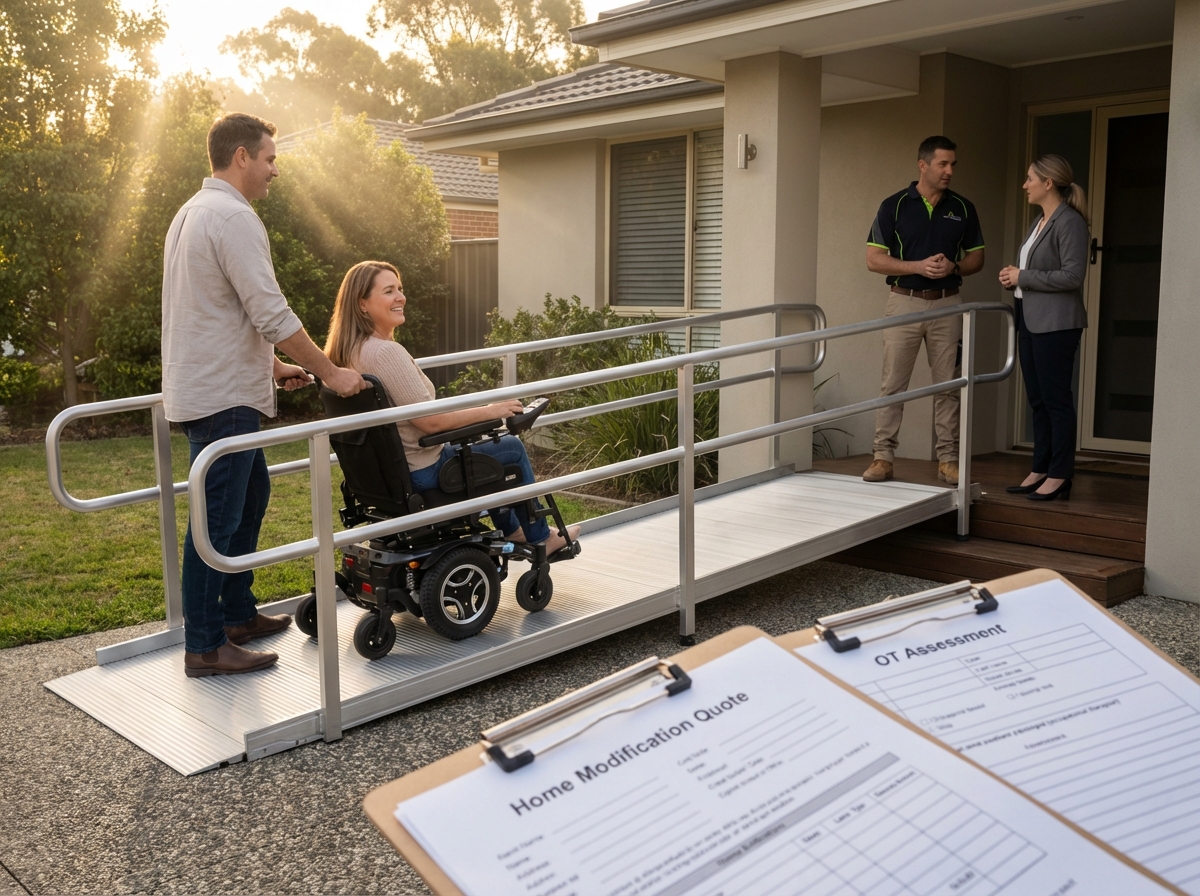
You generally need three written quotes from licensed contractors to satisfy grant requirements. Each quote must show a full scope of work and a detailed cost breakdown. It should list the specific materials like pressure-treated wood or modular aluminum. The specifications must follow ADA guidelines to ensure the ramp is safe and durable. This means a slope of 1:12. For every inch of vertical rise, you need one foot of ramp length. The quotes should include handrail heights and a plan for local permits. Ask the contractor to separate labor costs from material costs in their final estimate.
| Document Category | Required Items for Submission |
|---|---|
| Medical Records | Physician order. OT/PT assessment. Mobility notes. |
| Home Evidence | Entryway photos. Rise measurements. Barrier descriptions. |
| Contractor Bids | Three itemized quotes. ADA specs. Permit plans. |
| Administrative | Income proof. Residence proof. ID. DD214 for veterans. |
Administrative Paperwork and Identification
Financial and Residency Proof
Gather your proof of income early in the process. This includes tax returns from the last two years or recent pay stubs. Most home modification grants have strict income limits based on your area median income. You also need proof of residence like a utility bill or a property deed. Veterans must include their DD214 form to access specialized VA benefits like the HISA grant. Have your Medicaid or insurance ID card ready for scanning. You will likely need to sign consent forms that allow the funder to speak directly with your doctor or your contractor.
Templates for Success
Sample Physician Prescription
Patient Name: Jane Doe
DOB: 05/12/1960
Diagnosis: ICD-10 G82.20 Paraplegia
Medical Necessity: Patient is unable to navigate the four-step entry to the primary residence. A permanent ramp is required for safe egress and access to medical care.
Expected Duration: Permanent
Physician Signature: Dr. Robert Smith
Date: 12/24/2025
Sample Appeal or Narrative Paragraph
I am appealing the denial of coverage for a residential ramp. My current mobility limitations prevent me from safely entering or exiting my home. The lack of a ramp has resulted in two documented falls in the last six months. Providing this modification is a cost-effective alternative to emergency room visits or long-term institutional care. The attached therapist assessment confirms that a ramp is the least restrictive and most appropriate solution for my functional independence.
Support Systems and Follow-Up
Independent Living Centers
Independent Living Centers are excellent resources for assembling these packages. These organizations have case managers who understand the local grant landscape and the specific requirements of different funders. They can help you compile your documentation and ensure nothing is missing. They often know which local contractors are reliable and familiar with the permit process. A case manager can also track your submission and handle the necessary follow-up calls with the funding agency.
Organization and Timelines
Keep a digital folder with all your scanned documents on your computer. Name each file clearly with your last name and the document type. Follow up with the funding agency every two weeks after you submit the package. Ask if they have all the necessary information or if they need additional clarification. Keep a log of every person you spoke with and the date of the conversation. Most grant decisions take between two and eight weeks once the application is considered complete.
Costs permits contractors ramp types and ADA best practices
Choosing the right ramp involves balancing immediate mobility needs with long-term property value. In 2025, the market for home modifications has shifted toward modular and low-maintenance solutions. Homeowners are spending more on these improvements than in previous decades. According to the [PDF] Improving America’s Housing 2025 report, high-spending homeowners now drive a significant portion of the improvement market. This reflects a growing commitment to aging in place safely.
Ramp Costs and Material Options in 2025
Budgeting for a ramp requires looking at both the initial price and the cost of ownership. Prices vary based on the complexity of the yard and the height of the entrance. A standard 12-foot ramp for a single step will cost significantly less than a multi-level system for a high porch.
| Ramp Material | 2025 Installed Cost (Per Foot) | Maintenance Requirements |
|---|---|---|
| Pressure-Treated Wood | $80 to $150 | Annual sealing plus staining |
| Modular Aluminum | $100 to $300 | Occasional cleaning with water |
| Poured Concrete | $150 to $400 | Sealing cracks every few years |
| Prefabricated Kits | $70 to $200 | Varies by material type |
Modular Aluminum Ramps
These systems are the most popular choice for residential use today. They are durable and do not rust. Installation is fast because they arrive in pre-made sections. A median price for an installed aluminum system is around $120 per linear foot. They are ideal for people who need a solution quickly or might move in the future. These ramps can be disassembled and sold or moved to a new home.
Permanent Wood Ramps
Wood is often the most affordable upfront option. It blends well with home aesthetics. However, wood requires the most work over time. It can warp, rot, or become slippery when wet. Labor for a wood ramp usually takes 16 to 40 hours depending on the size. You must factor in the cost of non-slip grip tape or textured paint to ensure safety.
Concrete Ramps
Concrete is the most permanent and expensive solution. It is best for new construction or major renovations. The labor rate for concrete crews in 2025 ranges from $60 to $120 per hour. While the cost is high, concrete offers the best traction and longevity. It can last over 30 years with minimal care.
Powered Platform Lifts
When space is too tight for a long ramp, a vertical platform lift is the best alternative. These lifts act like small open-air elevators. The median cost for a residential lift in 2025 is $15,000. They are appropriate for high porches where a ramp would require too many turns or take up the entire yard.
ADA Best Practices for Residential Safety
The Americans with Disabilities Act (ADA) sets standards for public buildings. While these rules do not strictly apply to private homes, they are the gold standard for safety. Following them ensures the ramp is usable for everyone. For more details on overall project costs, you can check the Cost of Making a Home Wheelchair Accessible in 2025 – Angie’s List.
The One to Twelve Slope Rule
The most important standard is the slope. For every 1 inch of vertical rise, you need 12 inches of ramp length. If your porch is 24 inches high, you need a 24-foot ramp. Steeper slopes are dangerous because they are difficult to climb and can cause a wheelchair to tip backward. If space is limited, you must use landings to create a switchback design.
Landings and Width
A ramp needs a level landing at the top and bottom. These should be at least 60 inches by 60 inches. This space allows a person to open a door or turn around safely. The clear width of the ramp should be at least 36 inches. This provides enough room for the wheels and the person’s hands on the rails.
Handrails and Edge Protection
Handrails should be placed on both sides at a height of 34 to 38 inches. They must be easy to grip. Edge protection is also vital. A 2-inch curb along the sides prevents wheels from slipping off the edge. Surface traction is the final safety piece. Aluminum ramps often come with a ribbed texture. Wood and concrete need a broom finish or grit-infused coating.
Permits and Contractor Vetting
Most cities require a building permit for any permanent structure. Permit fees usually range from $50 to $500. Obtaining a permit involves submitting a site plan that shows the slope and materials. This step is necessary for several reasons. First, it ensures the ramp meets local safety codes. Second, many grant programs will not release funds without a final inspection. Third, unpermitted work can cause problems when you try to sell your home later.
Vetting Your Contractor
Always use a licensed and insured contractor. Ask for a certificate of insurance that shows general liability and workers’ compensation coverage. A reputable professional will provide a written contract. This contract should include the scope of work, the materials used, and a clear timeline. Use a staged payment plan. A common structure is 30 percent upfront, 40 percent when the materials arrive, and 30 percent after the final inspection. Never pay the full amount until the permit is closed and you have a lien waiver in hand. This waiver protects you if the contractor fails to pay their material suppliers.
Pro-Bono and Reduced-Cost Options
If market rates are out of reach, look for local trade programs or nonprofits. Organizations like Rebuilding Together or Habitat for Humanity often have volunteer crews. These groups can reduce labor costs by 50 to 100 percent. Some local high schools or community colleges with construction programs take on ramp builds as student projects. You may still need to pay for materials, but the savings on professional labor can be thousands of dollars.
Frequently Asked Questions about paying for ramps
Will Medicare ever pay for a residential ramp?
Medicare Part B does not pay for the purchase or installation of a permanent residential ramp. The program classifies ramps as convenience items or home modifications rather than Durable Medical Equipment (DME). Even if a physician provides a prescription stating the ramp is medically necessary for a wheelchair user, Medicare typically denies the claim. Some Medicare Advantage plans began offering small allowances for home safety modifications in recent years, but these are plan-specific and often capped at low amounts. You should check your Evidence of Coverage document for the current year to see if environmental supports are listed. If you have a Medicare Advantage plan, call the member services number on your card. Ask if your plan includes a supplemental benefit for home accessibility. Use this wording: “Does my plan cover any environmental accessibility adaptations under the supplemental benefits for the 2026 benefit year?” Most traditional Medicare beneficiaries will need to look toward Medicaid or private grants instead.
Why is a ramp treated as a home modification instead of DME?
The legal distinction comes from federal regulations like 42 C.F.R. §410.38. To qualify as DME, an item must be primarily medical in nature and not useful to someone who is not ill or injured. It must also be movable. Because a ramp is attached to the structure of a house, it is viewed as a permanent improvement that increases the value of the property. Insurance companies argue that a ramp benefits anyone entering the home, such as a delivery person or a guest with a stroller, which disqualifies it from being a strictly medical device. This classification is the primary hurdle for funding. You can read more about these distinctions in this guide on Home Modification Grants and Loans for Persons with Disabilities. Understanding this logic helps you prepare for the inevitable insurance denial and move quickly to secondary funding sources.
How do I find my state Medicaid HCBS waiver eligibility?
Medicaid is the most common public payer for ramps through Home and Community Based Services (HCBS) waivers. These programs are designed to keep people out of nursing homes by funding home changes. To find your local program, search online for your state name followed by the keywords “1915(c) waiver home modifications” or “environmental accessibility adaptations.” You can also contact your local Area Agency on Aging or an Independent Living Center. These offices help navigate the functional assessment process. The timeline for approval usually ranges from 2 to 12 weeks once you are in the system. When you call, use this wording: “I am a Medicaid recipient and I need to request a functional assessment for the HCBS waiver to fund a wheelchair ramp for my primary residence.” Be aware that many states have lifetime caps on these benefits, often ranging from $5,000 to $20,000.
Can the VA help pay for a ramp?
Yes, the Department of Veterans Affairs offers several robust grants for eligible veterans, including the Specially Adapted Housing (SAH) grant and the Home Improvements and Structural Alterations (HISA) grant. You should contact a VA Specially Adapted Housing agent at your regional VA office. The HISA application is generally faster, taking about 6 to 12 weeks for approval. Use this wording when calling: “I am a veteran with a mobility limitation and I would like to apply for a HISA grant to install a ramp at my home.” You will need a written prescription from a VA physician that describes your medical need for the modification.
What documentation is most persuasive for grants and appeals?
Success depends on proving that the ramp is a medical necessity rather than a luxury. The most important document is a functional mobility assessment from a physical or occupational therapist. This report should include your fall history, transfer scores, and a statement that you cannot safely enter or exit your home without a ramp. You also need three itemized quotes from licensed contractors that specify an ADA-compliant 1:12 slope. Include dated photos of your current entrance to show the barriers. If you are appealing a denial, include a cost comparison. Show that the $4,348 average cost of a ramp is much lower than the cost of a single emergency room visit for a fall. You can find more on typical pricing in this article about the Cost of Making a Home Wheelchair Accessible in 2025. Gathering these records usually takes about 7 to 14 days.
How long do grant waits typically take?
Timelines vary by the type of organization. Local nonprofit grants from groups like Rebuilding Together or Habitat for Humanity often take 4 to 10 weeks depending on their volunteer schedule. Government programs like the USDA Section 504 grant or HUD-funded local programs can take 3 to 6 months due to income verification requirements. If you are applying for a state Medicaid waiver, expect a wait of at least 30 days for the initial home visit. Because these processes are slow, you should apply to multiple sources simultaneously. Keep a log of every person you speak with and the date of the conversation. If a program tells you they are out of funds for the year, ask when their new fiscal year begins so you can be first in line for the next round of funding.
Are portable ramps safe and when are they acceptable?
Portable ramps are safe for very small rises like a single step or a door threshold. They usually cost between $50 and $300. However, they are not a safe long-term solution for high porches. A standard 1:12 slope means you need one foot of ramp for every inch of rise. A typical three-step entrance has a 21-inch rise, which requires a 21-foot ramp. A short portable ramp used on a high rise creates a dangerously steep incline that can cause a wheelchair to tip backward. Only use portable ramps for rises under 6 inches or as a temporary bridge while waiting for a permanent modular system. Always check the weight capacity to ensure it can support both the user and the mobility device.
Do tax deductions apply for home modifications and how to claim them?
The IRS allows you to deduct the cost of a ramp as a medical expense if its primary purpose is medical care. This is covered under IRS Publication 502. You can only deduct the portion of the cost that does not increase the value of your home. However, the IRS generally assumes that ramps do not increase property value, so the full cost is often deductible. You must itemize your deductions on Schedule A. The total of all your medical expenses must exceed 7.5 percent of your adjusted gross income to see a benefit. Save your contractor contract, the physician’s prescription, and your proof of payment. Consult a tax professional to ensure you are meeting the current 2025 filing requirements.
What are quick emergency options when a ramp is needed immediately?
If you are being discharged from a hospital and cannot wait for grant approval, look into ramp rentals. Many medical supply companies rent modular aluminum ramps for approximately $100 per week. This allows you to get home safely while your grant application is pending. Another option is to contact a local Assistive Technology (AT) loan closet. These programs often lend out used modular ramp sections for free or at a very low cost. Search for your state name plus the keywords “Assistive Technology Act Program” to find the nearest equipment loan center. You can also buy a small threshold ramp from a local pharmacy for immediate access over a door sill. These quick fixes can be set up in a single afternoon while you work on long-term funding.
Final thoughts and next steps
Securing a residential ramp requires a shift in how you view home accessibility. Insurance companies usually categorize these structures as permanent home improvements rather than medical equipment. This distinction often leads to immediate denials. You can overcome these hurdles by treating the search for funding like a professional project. Success depends on your ability to gather evidence and navigate multiple agencies at once. Most families find that a single source rarely covers the entire cost. You might need to combine a small grant from a local nonprofit with a state tax credit or a veteran benefit. This approach requires organization and a refusal to take the first “no” as a final answer.
Step 1. Establish medical necessity with professional backing
Your first task is to build a clinical case for the ramp. A simple prescription from a doctor is rarely enough for grant committees or Medicaid reviewers. You should schedule a functional assessment with a physical or occupational therapist. Ask them to document your specific mobility limitations in detail. This report should include your history of falls and your inability to navigate stairs safely. It needs to mention objective measures like your gait speed or balance scores. Ensure the therapist explains why a ramp is the only safe solution for your home. This documentation serves as the foundation for every application you submit. It proves that the ramp is a medical need rather than a home renovation project.
Step 2. Connect with local and federal caseworkers
You should reach out to experts who understand the funding landscape in your specific area. Contact your local Independent Living Center to speak with a housing advocate. There are approximately 450 of these centers across the country. They often maintain lists of local charities and state programs that provide minor home modifications. If you are a veteran, you must contact your VA caseworker to discuss the Home Improvements and Structural Alterations grant. This program offers up to $6,800 for service-connected conditions. If you are enrolled in Medicaid, ask your caseworker about Home and Community Based Services waivers. These waivers frequently include environmental accessibility adaptations as a covered service. These professionals can help you identify which programs are currently accepting applications.
Step 3. Collect itemized contractor quotes and site photos
Grant providers require concrete data before they release funds. You need to obtain three written bids from licensed contractors who have experience with ADA standards. Each quote should be itemized to show the cost of materials and labor separately. Ensure the contractors specify the slope of the ramp. A 1:12 ratio is the standard for safety. You should also take clear photos of the entrance where the ramp will be installed. Include a photo of the steps with a measuring tape showing the total height. This visual evidence helps reviewers understand the physical barriers you face every day. Having these documents ready will prevent delays when an application window opens.
Step 4. Identify two distinct funding paths
You should pursue at least two different routes to ensure you have a backup plan. Your primary path should be a government or nonprofit grant. This might include a USDA Section 504 grant if you live in a rural area. You could also look into the Home Modification Grants and Loans for Persons with Disabilities to see which federal options fit your income level. Your second path should be a private fallback option. This could be a low-interest loan from a Community Development Financial Institution. You might also consider the medical expense tax deduction. The IRS allows you to deduct home modifications if they are primarily for medical care. This applies if the costs exceed 7.5 percent of your adjusted gross income. Having a private option ensures you can move forward if a grant falls through.
Step 5. Prepare an appeals template for potential denials
Denials are a common part of the process. You should prepare a response letter before you even receive a decision. This template should quote the specific medical necessity language from your therapist. It should also include a cost-comparison argument. Explain that the cost of a ramp is significantly lower than the cost of a single emergency room visit or a stay in a rehabilitation facility. According to Improving America’s Housing 2025, the market for home improvements is growing. This means contractors are busy and prices are firm. An appeal that highlights the long-term savings for the insurer or the state can be very persuasive. Having this letter ready allows you to file an appeal immediately and keep your project on track.
Persistence is the most important factor in this process. You should keep a detailed log of every phone call and email. Note the name of the person you spoke with and the date of the conversation. Timelines for these programs vary significantly. Medicaid waiver approvals can take anywhere from 2 to 12 weeks. Nonprofit applications might take 4 to 10 weeks depending on their volunteer schedule. HUD programs often operate on 3 to 6 month cycles. You should expect to wait several months for a final decision. If you encounter legal barriers or complex insurance language, you may want to seek help from a benefits counselor. They can provide guidance on navigating the bureaucracy. You should keep a folder with your doctor’s orders, your tax returns, and your contractor bids. Having these documents handy will make the process much smoother as you move toward your goal of a safer home.
Sources
- Home Modification Grants and Loans for Persons with Disabilities — TRA grants are up to $49,062 in FY 2025 for SAH-qualified … See full bio. Helpful resources. Best Home Improvement Loans of 2025.
- [PDF] Improving America's Housing 2025 — Consequently, high-spending homeowners expanded their share of the improvement market to 44 percent in 2023, the highest concentration of spending recorded …
- [PDF] Government Programs that Subsidize Home Modifications to … — The program provides grants of up to $15,000 to homeowners making 30 percent AMI or less and where at least one household member is age 55 or …
- Housing Grants for Veterans: 7 Powerful Ways to Secure Success … — This grant helps with focused modifications like widening doorways, installing grab bars, or adding ramps to make daily life more manageable.
- The Cal Aim Home Modifications Benefit is Effective and Lowers … — Analysis of Q4 2023–Q3 2024 data demonstrate substantial reductions in high-cost healthcare utilization. Continued funding of this benefit is …
- Grants for People with Disabilities (Updated in 2025) — Grants of up to $3,600 are available per year and can be used toward equipment, minor home modifications, and other disability-related services. Montana …
- Cost of Making a Home Wheelchair Accessible in 2025 – Angie's List — Making a home wheelchair accessible costs $699 to $7,998, or $4,348 on average. A pro will factor in the specific standards outlined by the …
- The 2025-26 Budget: In-Home Supportive Services — The Governor's 2025-26 budget proposes approximately $10.6 billion General Fund, an increase of $1.1 billion (11 percent) from the Governor's revised 2024-25 …
- A Systematic Review of Home Modifications for Aging in Place in … — This study systematically reviews home modifications, addressing these gaps by considering functional independence, quality of life, caregiving burden, and …
- HUD Home Modification Grants Open Until October 13 — HUD has $15 million in OAHMP grants to distribute to eligible entities, including nonprofit organizations. The grants will fund “comprehensive …
Legal Disclaimers & Brand Notices
The information provided in this article is for informational purposes only and does not constitute medical advice. Discussions regarding medical necessity, clinical assessments, and patient recovery are intended for educational purposes and should not be used as a substitute for professional medical consultation, diagnosis, or treatment. Always seek the advice of a physician or other qualified health provider with any questions you may have regarding a medical condition or safety risks.
All product names, logos, and brands are property of their respective owners. All company, product, and service names used in this article are for identification purposes only. Use of these names, trademarks, and brands does not imply endorsement.